

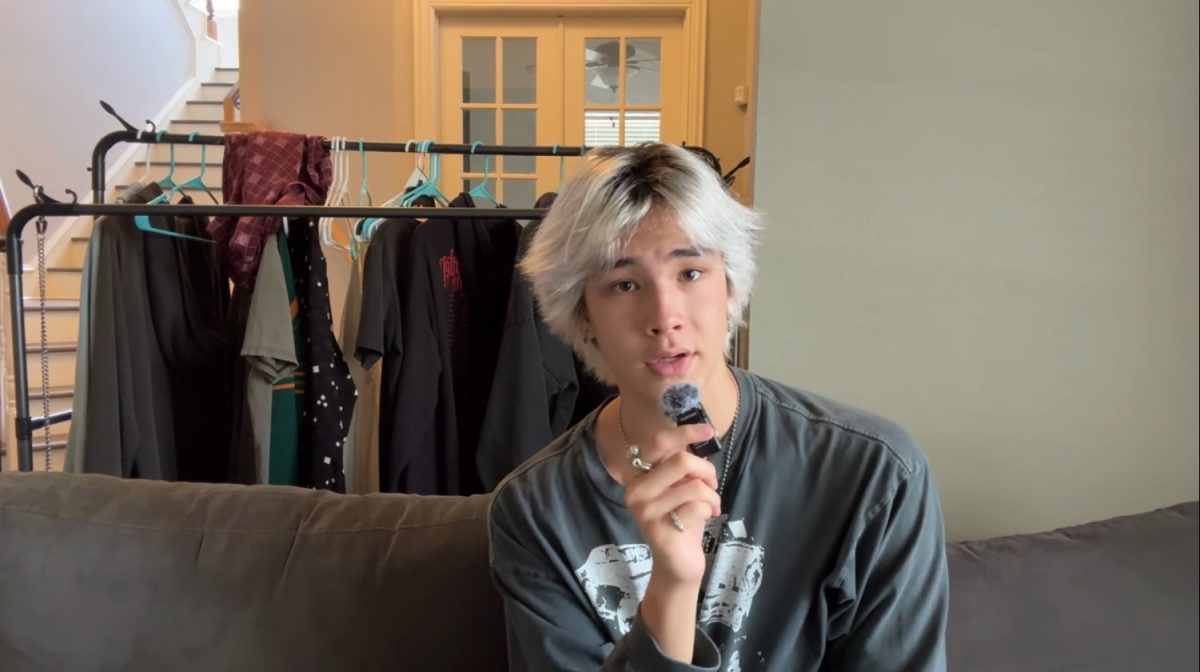
On his brown couch, he sits framed by a rack of clothes behind him.
The hangers, alternating between white and blue, hold pieces in shades of black, gray and white.
With a handheld mic at his mouth, he begins greeting his viewers, then throwing cultural references as quick edits and visuals flash across the screen, showing what he’s describing.
Worldwide, there is a growing movement of youth enthusiastic for collecting, learning and selling archival fashion. In 2023, #archivefashion content was viewed over 36 million times, with 91% of viewers aged 18-24.
Before the end of summer, senior Kai Rehagen, contributed to that statistic. Inspired by an influencer, he launched an archival fashion YouTube channel that highlights historically and culturally significant clothing.

“A year before I started making my content, I went down a rabbit hole of Bliss Foster’s videos,” Rehagen said. “I always had thoughts and opinions and just did a lot of research on my own, but I found that none of the research, [even if] it was all out there, wasn’t compiled into one place.”
In his videos, Bliss Foster, a fashion commentator and YouTuber, emphasizes how fashion is more than ‘what do I want to wear?’ He encourages his viewers who watch runway shows to take notes and think critically about fashion as an art.
“I feel like fashion media in general is very vapid, like nothing super in-depth,” Rehagen said. “I don’t think most people who are into fashion want to hear about the intelligent discussion behind it. People want to take fashion as art, but not a lot of people critique it or talk about it as an art form. [But] I think Bliss Foster does a great job of actually doing that.”
Rehagen figured the best way to get his research out there was through videos. This places his work among a growing number of digital fashion archivists, creators who preserve and contextualize fashion history through using online platforms, such as Instagram and YouTube, rather than museums or magazines, similar to Foster.
Rehagen got into fashion during his elementary and middle school years with brands like Supreme, Bape and Yeezys. Slowly, it evolved into a serious curiosity.
“Before it was just more consumerist like ‘what do I want to buy to look cool?’” Rehagen said. “Then it [became] more like what brands [fit my] personal style. But it wasn’t until watching [Foster’s] videos that I wanted to look into runways and see what’s behind this stuff and the art of it.”
So far, Rehagen has published eight long-form videos and 11 shorts on his channel. His first video, published in July, was an analysis of Number (N)ine, a Japanese fashion brand founded by Takahiro Miyashita, and its 2001 spring/summer collection ‘Time Migration’. After publishing the video, Foster reached out to Rehagen appreciating the work that he had done.

“I am thrilled to see more young people engaging with fashion the way that Kai has,” Foster said. “Part of what legitimizes an artform is rigorous examination from a well-informed audience. There was a time when novels were not taken seriously as art, same with comics, same with film. I’m happy to see that ride changing.”
To produce his videos, Rehagen mentions that it comes with a lot of brainstorming.
“Before I even start writing the script, I’m sitting around and thinking, ‘How does this connect to that?’ Or ‘How could I write this?,’” Rehagen said. “I do this with everything. With fashion, it’s an internal dialogue. I think about how someone would respond to my thoughts and then how I would respond back to get a more defensible idea out there.”
Once Rehagen’s thoughts are organized, he sits down to write the script—the most time-consuming part of the production process. After, he takes a day or two to put the video together, both recording and editing.
“The runway analysis takes longer because those are definitely more thought out,” Rehagen said. “Editing [it] can take a couple of hours as I have to go over every look and chop up the runway itself. But for some of the others where I’m going over references from a book or something, that takes less time cause I’m just telling them about it [and it’s] not as deep as the runway analysis. Depending on the video, I’ll make a Reddit post that goes along with it, so that takes some time too.”
Weeks later from his first video, Rehagen started to make videos on Enfants Riches Deprimes (ERD), an American luxury brand that translates from French to “Depressed Rich Kids.” ERD encapsulates a provocative aesthetic that’s heavily influenced by punk rock as it pulls references from obscure magazines from the 1970s and 1980s to avant-garde scenes from music and art. Avant-garde refers to works that are experimental or innovative. Here, ERD takes graphics from those magazines and incorporates them into its clothing.
“It gets a lot of hate because I don’t think people really understand it,” Rehagen said. “I went down that rabbit hole and published a whole bunch of videos on it. Personally, the whole idea of avant-garde art is something I really love [as] I’m super into experimental stuff. The way they utilize, reinterpret, and execute those graphics onto the clothes is right down my alley.”
While Rehagen’s fascination with the artistic and historical side of fashion drives his YouTube channel, he started one of his Instagram accounts—Cool Blue Archive—to post clothes he doesn’t wear anymore to help draw people to his channel and hopefully resell, a side of archival fashion he was first pulled into through his friend, senior Andrew Gandy.
“He’s the person who got me into the archive page stuff,” Rehagen said. “He’s been in the archive game way longer than I have, but he’s not exactly on the same page of fashion as art or looking at runway shows. He’s more of the reseller—one of the titans of industry in that space. We’re in different lanes, but his lane is just as interesting and he’s definitely bigger in that space than I am.”
Gandy first got into archival fashion during his sophomore year, when he began outgrowing his clothes. He had been into fashion since middle school and used to buy designer pieces, but discovered archival fashion after noticing the market and traction behind it.
“I started selling my grown out clothes and realized I was making money,” Gandy said. “So I reinvested into archival clothing and I was like, ‘Wow, I’m making a lot more money now.’ It turned into a rotating closet–the more money I would get, [the more] I would put into it, and I would learn more about the items, pieces, and creators, seeing how fashion [then] influences fashion today.”
Rehagen and Gandy shared AP Precalculus their junior year, which led them to bond over clothes.

“I would come into school wearing some of the clothes that I thought were cool, and he would be like, ‘Wow, what is this?’” Gandy said. “I would tell him and he’d be like ‘Isn’t that similar to this and that?’ It led me to show him my page, a couple things I get in my inventory, and he was like ‘How can I get started?’”
Gandy and Rehagen learned from each other through their interactions as they both introduced each other to new designers and sides of archival fashion.
“I was really into Rick Owens and Undercover, and he was more into Number (N)ine and Raf Simmons,” Gandy said. “We kind of swap[ped] ideas. He showed me the history of them, so I started looking into it. I even veered into some of what he liked because I saw that there was a market behind it, and [that] made me more interested. The same thing happened to him [when] I taught him a couple things that I used to find good deals, people to work with and what’s safe and what’s not.”
Apart from the YouTube channel and Cool Blue Archive, Rehagen has another Instagram account—Archive Reference—where he posts pieces and details the references behind them. Rehagen hopes to have this account be associated with his upcoming project.
“I’m working on a website to preserve a lot of fashion history,” Rehagen said. “There’s a lot of stuff I’m sitting on that I haven’t made a video about, and I’d like to just be able to publish that on a website [so] you don’t have to sift through the video [and] can just go to the website, find the piece easily, and learn about it.”
Having only started the YouTube channel a few months ago, Rehagen has already racked up more than 1,900 subscribers.
“I expected it and didn’t at the same time,” Rehagen said. “I really feel the videos are good, and [I’m coming] from the standpoint that I’m talking about stuff I have found so interesting and I know others have [too], but no one’s made it into a video, so I [thought it would] be good. But practically, people just grind on YouTube for a long time and nothing happens. For it to do as well as it did was definitely really crazy.”
Rehagen hopes not only to grow his channel but also to ensure that it creates a space in the fashion community that many places don’t curate.
“I’ve always admired the fashion community, but I also don’t like it [as] I feel like it’s not that great,” Rehagen said. “[Many] people gatekeep by holding on to information and purposely not talk about it. There have been people who have reached out to me and have given me tons of information–like for my first video as a lot of the information was from the Number (N)ine Discord server. So for [people] to reach out and tell me stuff and let me make videos is awesome and I want to be like that as well. I want to be the change. I don’t want to just sit back and hate on [the community] unless I’m contributing to making it better.”
Rehagen plans to continue this work, mainly to stay involved in the community.
“Everyone’s into [fashion] for their own reasons,” Rehagen said. “Someone’s going to be into it because they like the way it looks and don’t care about the story at all, and that’s totally fine. But if you’re interested, come to me and I will yap your ear off about it. And, if you know more than me, please come to me and tell me everything you know. I just want to have an open conversation with the community I foster [and] it’s cool to find people that care.”